
The short answer
Claude is the least-tracked major assistant and the one most likely to be quietly deciding your enterprise deals. Most AI visibility tools either skip it or bill it as an add-on. If you want it tracked properly, use a tool that samples every Claude model on a schedule and stores the answers - our Claude rank tracker does exactly that, and the honest survey of the alternatives is below.
Why Claude rank behaves differently
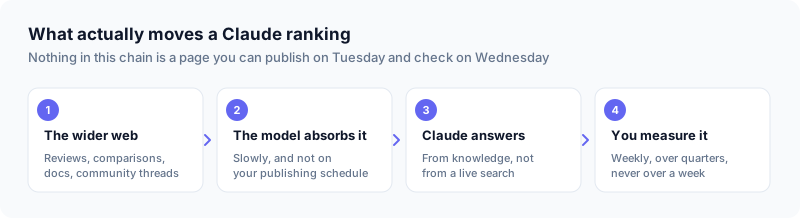
Every other engine in this category is search-grounded by default. Claude, on most category questions, is not. It answers from model knowledge. That single difference changes what you are measuring and what you can do about it.
| Search-grounded engines (Perplexity, Gemini, ChatGPT Search) | Claude | |
|---|---|---|
| Where the answer comes from | Live retrieval, then synthesis | Mostly model knowledge |
| How fast a new page can affect rank | Days | Slow - the source has to be widely absorbed |
| Citation list to track | Usually present | Often absent |
| What moves your position | Ranking and page structure | How consistently the web describes you |
| Right cadence | Daily to weekly | Weekly, with longer trend windows |
The practical consequence: you cannot fix a Claude ranking with a landing page. You fix it by changing what the wider web says about your category and where you sit in it - review platforms, comparison articles, documentation, community threads. That is a two-quarter project, which is exactly why measuring it from day one matters. If you only start tracking when you notice the problem, you have already lost the baseline.
What a Claude rank tracker has to do
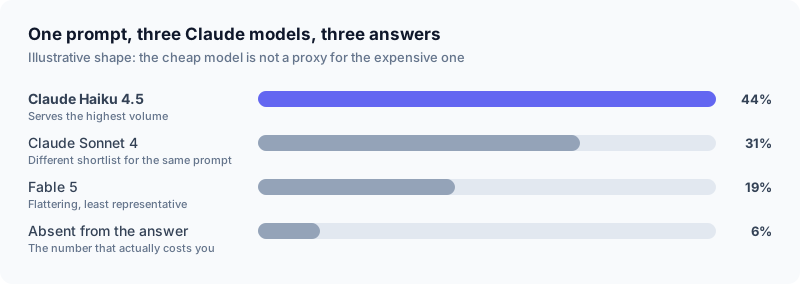
- Cover the model spread. Claude Haiku, Sonnet, and the larger Fable-class models produce different shortlists for the same prompt. The cheap model is not a proxy for the expensive one; in our sampling they disagree on the top three more often than they agree.
- Sample repeatedly. Claude is less volatile than Grok but still non-deterministic. Five runs per prompt per check is the floor.
- Read position out of prose. Claude often answers in paragraphs rather than a numbered list. A tracker that only parses numbered lists will score you absent from answers that named you.
- Track sentiment, not just presence. Claude qualifies its recommendations heavily ("good if you need X, but consider Y"). Being named third with a warm qualifier beats being named first with a caveat, and only sentiment capture shows that.
- Store the raw answer. Especially here, where the answer text is the only evidence - there is usually no citation list to fall back on.
The tools
Livesov
Tracks Claude across Haiku 4.5, Sonnet 4, and Fable 5, on a schedule, with multi-run sampling, sentiment, competitor benchmarking against up to 20 rivals, and full response storage. Claude is included on every paid plan from $9/mo rather than sold as an engine add-on, and the 7-day trial needs no card. See the Claude rank tracker for the mechanics and Claude brand tracking for the mention-and-sentiment view.
Profound
Enterprise platform with Claude coverage among its engines. Strong reporting, services attached, priced for large organisations - public reports put entry around $99/mo before the enterprise tiers. Fuller breakdown on the Profound alternative page.
Peec AI
Clean, well-built, popular in Europe. Check which engines your tier includes before committing; engine coverage is the variable that decides the real cost of these comparisons. See the Peec AI alternative page.
Evertune, Bluefish, AthenaHQ
Enterprise-leaning platforms that treat AI representation as brand governance. Several cover Claude. All involve a sales process, so budget the evaluation time as well as the licence. We keep comparison pages for Evertune, Bluefish, and AthenaHQ.
The lighter tools
Rankscale, Knowatoa, LLMrefs, Waikay and similar tools vary in whether Claude is covered at all, and change fast. Check their current engine list directly rather than trusting a comparison article - including this one - to be current.
Free Claude rank tracking: what is actually possible
Honest version: there is no free tool that gives you scheduled, multi-run Claude rank tracking, because every run is a paid API call to Anthropic. What does exist:
- Free one-off checkers. Run a prompt, see an answer. Fine for a first look, useless as a trend. Several live in our free tools hub with no signup.
- A spreadsheet and your own API key. Genuinely viable if you are technical: query the Claude API on a cron, log the answer, parse for brand names. You will spend a weekend building it and then discover the hard part is not collection, it is parsing position out of prose consistently.
- Trials. Livesov's is 7 days with no card. Most competitors want a demo call first.
We wrote a fuller piece on what free actually buys you across engines: free AI rank trackers.
A test that takes twenty minutes
Ask Claude your five most commercially important category questions, five times each, in a fresh conversation every time. Write down every brand named, in order.
Two numbers fall out. Your presence rate - how many of the 25 answers named you at all. And your average position among the named brands. If presence is under 40%, you do not have a ranking problem, you have an absence problem, and the fix is off-site: reviews, comparisons, and third-party coverage, not your own blog.
Then run the same five prompts in ChatGPT and Perplexity. The spread between engines is usually wider than anyone expects, and it tells you where to spend.
FAQ
What is the best Claude rank tracking tool?
The one that covers every Claude model, samples each prompt several times on a schedule, captures sentiment as well as presence, and stores the raw answers. Livesov does this from $9/mo with Claude included; Profound and Peec AI do it at enterprise pricing. Verify current engine coverage on any tool before buying - it changes often.
Is there a free Claude rank tracker?
No tool offers free scheduled Claude tracking, because each run costs an API call. Free one-off checkers exist, and Livesov's 7-day trial needs no credit card, which is the closest thing to free continuous tracking.
Why is my Claude rank different from my ChatGPT rank?
Different training data, different retrieval behaviour, different answer style. Claude leans on model knowledge for category questions where ChatGPT may search. A brand strong in recent web content often ranks better in ChatGPT; a brand with long-standing third-party coverage often ranks better in Claude.
Does Claude cite sources I can track?
Sometimes, on prompts where it uses web access, but far less consistently than Perplexity or grounded Gemini. Plan your measurement around answer position and sentiment, and treat citations as a bonus rather than the primary metric.
How do I improve my Claude ranking?
Change what the web says about you, not just what you say about yourself. Get accurate, current entries on the review platforms and comparison sites that cover your category, keep your own documentation clean and factual, and fix inconsistent descriptions of what you do. Then measure over quarters, not weeks - start a free trial to get the baseline before you begin.