
The short answer
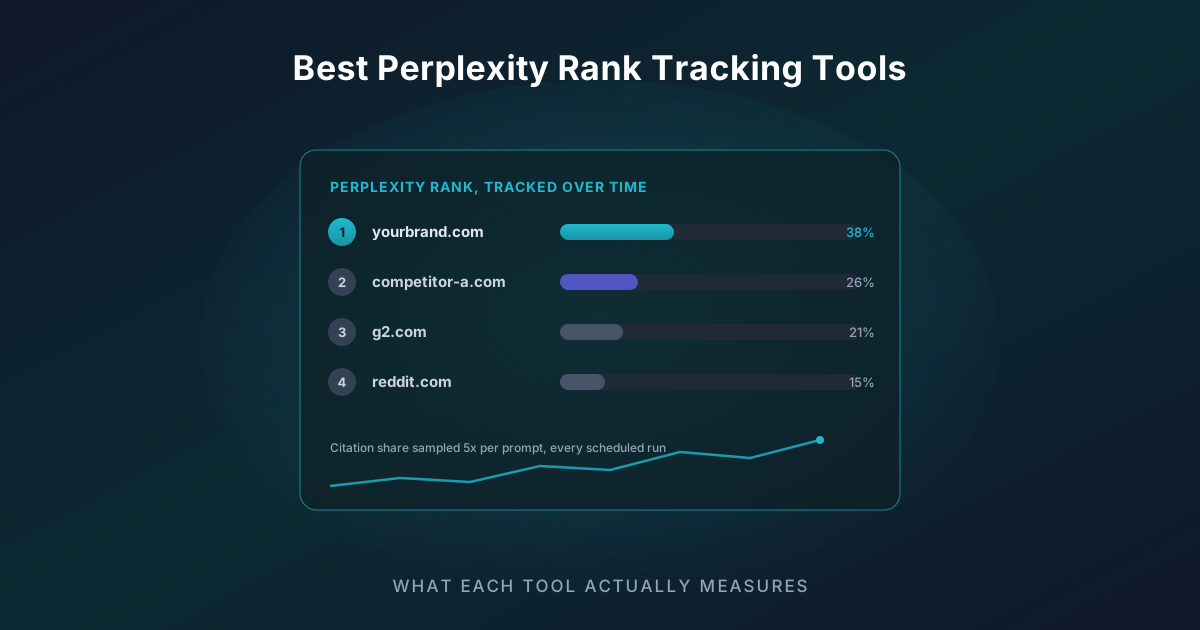
If you want one tool that tracks your Perplexity rank, your citation share, and your competitors on a schedule, with the full answer stored as evidence, use a purpose-built AI rank tracker rather than a Google rank tracker with an AI add-on. The Perplexity rank tracker is the page that explains how ours works; this article is the honest survey of the field around it.
The important thing to understand before you compare prices: Perplexity is the easiest AI engine to track and the easiest one to track badly. It shows a numbered source list on every answer, which tempts tools into reporting a single citation position as if it were a rank. It is not. Perplexity answers are non-deterministic - ask the same question twice and the sources reorder - so any number produced from one run is closer to a coin flip than a metric.
What "Perplexity rank tracking" actually means
Three different measurements get sold under the same name. Know which one you are buying.
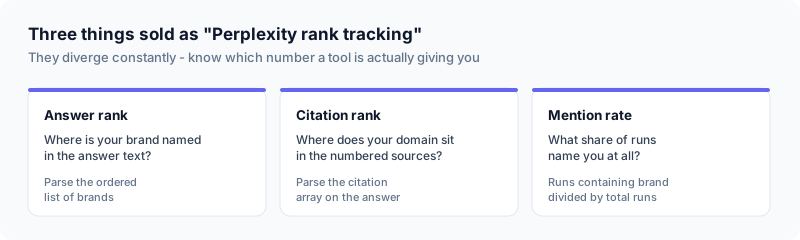
They diverge constantly. A brand can be cited as source #2 and never named in the answer text - Perplexity read your page and credited someone else's framing. That gap is the single most actionable finding in Perplexity tracking, and a tool that reports only one of the three will never show it to you.
What separates a real tracker from a checker
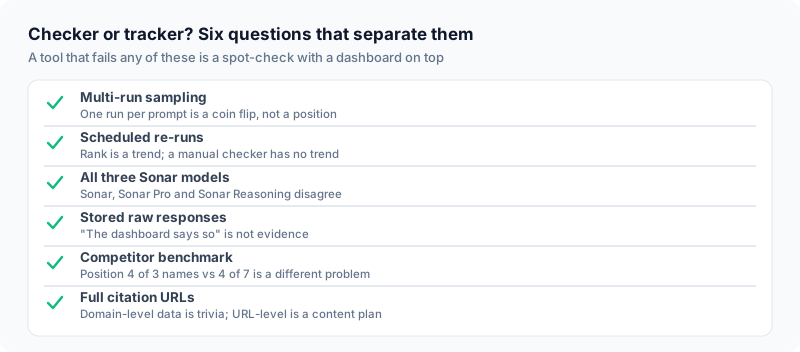
Most of what markets itself as a Perplexity SEO tracking tool is a checker: you type a prompt, it runs it once, it shows you the answer. Useful for five minutes. The criteria that matter over a quarter:
- Multi-run sampling. One run per prompt is noise. Anything that reports a rank from a single query is measuring variance, not position.
- Scheduled re-runs. Rank is a trend. A tool without a scheduler is a tool you will stop opening after week two.
- Model coverage. Sonar, Sonar Pro, and Sonar Reasoning answer differently. Sonar Pro retrieves more sources; Reasoning restructures the answer entirely. Tracking one and calling it Perplexity is a coverage claim you cannot back.
- Stored raw responses. When a client asks why their rank dropped, "the dashboard says so" is not an answer. The stored answer text is.
- Competitor benchmarking on the same prompt. Your rank means nothing without the field. Being #4 in a three-name answer is impossible; being #4 in a seven-name answer is a different problem than being absent.
- Citation URL capture, not just domain. Knowing perplexity cited yourdomain.com is trivia. Knowing it cited /pricing rather than your comparison page is a content decision.
The tools worth comparing
Livesov
Purpose-built AI rank tracking across all five major engines, Perplexity included. Runs each prompt several times per scheduled check across Sonar, Sonar Pro, and Sonar Reasoning, records answer position and the full ranked citation list, benchmarks up to 20 competitors on the same prompts, stores every raw response, and charts the trend. Free 7-day trial with no card, plus a free GEO audit and a set of free tools that need no signup. Paid plans start at $9/mo and include every engine - Perplexity is not an add-on.
Best for: teams that want Perplexity tracked properly alongside the other four engines without paying per engine.
Profound
The best-funded enterprise platform in the category, with content production and managed-service motions attached. Deep Perplexity coverage, priced and sold accordingly - public reports put entry around $99/mo, and the buying process usually involves a demo. See the Profound alternative page for the feature-by-feature version.
Best for: enterprises that want AI visibility run as a programme with services attached.
Peec AI
Well-regarded European tool with a clean interface and strong reporting. Public reports put entry around $100/mo. Worth checking which engines are included at your tier rather than assuming - the total cost of covering multiple engines is where these comparisons usually turn. Details on the Peec AI alternative page.
Otterly.ai
Covers surfaces most AI trackers do not, including Google AI Overviews and AI Mode. Entry plan is around $29/mo for a small prompt allowance. If Google's AI surfaces matter to you as much as Perplexity does, this is a genuine differentiator - we say so plainly on the Otterly alternative page.
Rankscale, Knowatoa, LLMrefs, Waikay
A cluster of newer, lighter tools, each with a different emphasis - scoring, prompt discovery, citation lookup. All are moving fast enough that any pricing we print here would be wrong by the time you read it. Check current plans on their own sites, and test each against the six criteria above rather than the feature list on the landing page.
Semrush and Ahrefs
Both have shipped AI visibility features. Both are excellent at what they were built for, which is Google. If you already pay for one, the AI module is a reasonable first look at whether you have a problem. It is not, yet, a Perplexity rank tracker in the sense this article means - the sampling depth and citation-level detail are not there. We wrote up the honest comparison at Livesov vs Semrush and Livesov vs Ahrefs.
How to evaluate one in an afternoon
Do not compare feature grids. Run this test on any tool with a trial:
- Pick five prompts a real buyer would type. Not your brand name. "Best [category] tool for [use case]" beats "what is [your brand]" every time.
- Run each prompt five times in the tool, then five times manually in Perplexity. If the tool's reported rank is stable while your manual runs vary wildly, the tool is smoothing something it should be showing you.
- Check whether the citation list is complete. Count the sources in the live answer, count what the tool stored. Truncation at five or ten sources is common and quietly changes every share-of-voice number downstream.
- Change a page, then wait a cycle. The only test that matters is whether the tool detects a change you deliberately caused.
- Export the evidence. If you cannot get the raw answer text out, you cannot defend the number to a client or a CFO.
The mistake almost everyone makes
Tracking Perplexity in isolation. Perplexity is the most transparent engine, which makes it the most satisfying to measure - the source list is right there. That is exactly why teams over-index on it and end up optimising for the engine that is easiest to see rather than the one their buyers use.
The fix is not complicated: track it alongside the others and look at the spread. Our LLM rank tracker page covers the cross-engine view, and if your buyers skew technical, the Claude rank tracker is usually the second engine worth adding, not ChatGPT.
FAQ
What is the best Perplexity rank tracker?
The one that samples each prompt multiple times across Sonar models, stores the full citation list, benchmarks competitors on identical prompts, and re-runs on a schedule. Livesov does this from $9/mo (all five engines on Agency); Profound and Peec AI do it at enterprise price points; Otterly adds Google AI surfaces. Match the tool to which engines you actually need.
Is there a free Perplexity SEO tracking tool?
There are free one-off checkers, including several in our own free tools hub, and they are fine for a first look. No free tool gives you scheduled multi-run tracking, because every run costs an API call. Livesov's 7-day trial needs no card, which is the closest honest answer to "free Perplexity rank tracking".
How often should I track Perplexity rank?
Daily in competitive categories, weekly in stable ones - with several runs per check either way. The cadence matters less than the multi-run sampling; a weekly check averaged over five runs is far more useful than a daily check taken once.
Does ranking in Google help me rank in Perplexity?
It helps, because Perplexity retrieves live search results before it answers. It does not determine the outcome. Perplexity re-ranks retrieved sources on how cleanly they answer the specific question, which is why a well-structured page at Google position 8 routinely gets cited over a sprawling one at position 2. Run a GEO audit on the page you want cited to see the gap.
What is the difference between Perplexity rank tracking and brand tracking?
Rank tracking measures your position for specific prompts over time. Brand tracking measures whether and how you are mentioned and cited at all. Both are on this site - Perplexity brand tracking for the mention angle, and the rank tracker for position. Most teams need both, and the mention data usually explains why the rank moved.