
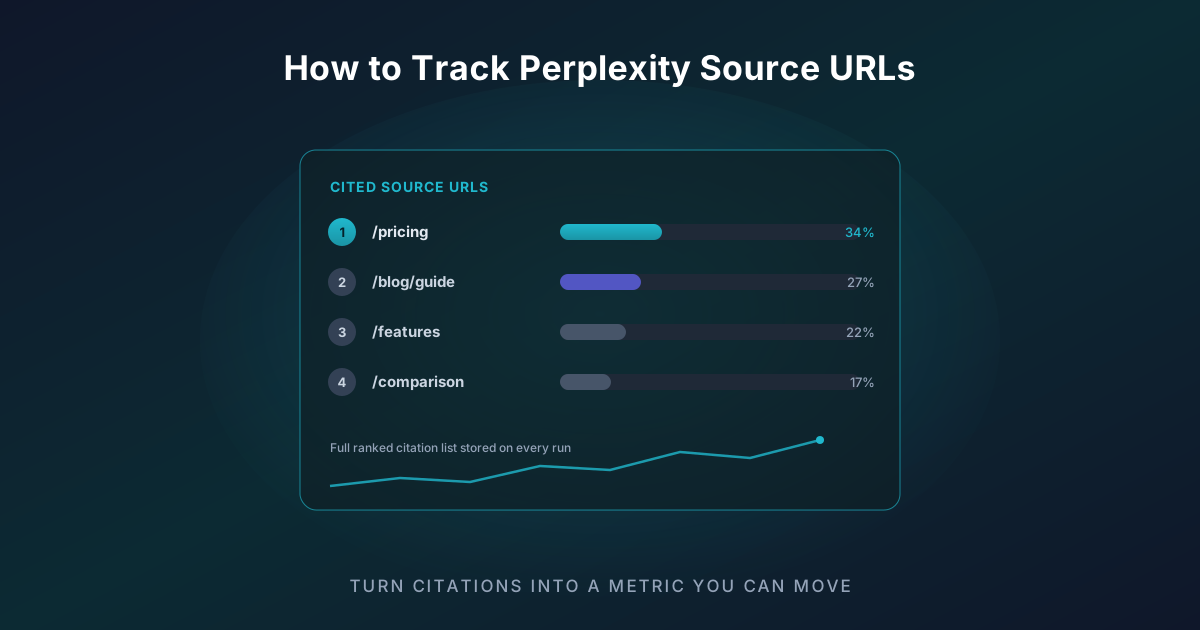
Why source URLs are the most useful data in AI search
Perplexity is the only major engine that hands you its working. Every answer arrives with a numbered list of the URLs it read. That list is the closest thing AI search has to a SERP, and unlike a Google SERP it tells you not just who ranked but what the model actually consumed to build the answer.
Tracked over time, those URLs answer questions nothing else can:
- Which of your pages earns citations, and which never gets read despite ranking in Google?
- When a competitor overtakes you, which specific page did it?
- Are you losing to competitors, or to review platforms and Reddit threads that neither of you controls?
- Does the page you optimised last month actually get cited now?
The two ways to capture them
1. Manual, for a one-off audit
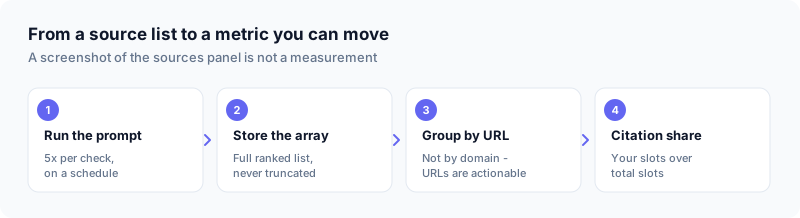
Run your prompt in Perplexity, expand the sources panel, copy the URLs into a sheet. Repeat five times per prompt because the list changes between runs. Do this for ten prompts and you have 50 runs and a decent afternoon's work.
This is worth doing once. It teaches you what your citation landscape looks like, and it is the only way to be sure any tool you buy later is reporting reality. It is not a system - you will not repeat it monthly, and a citation snapshot with no trend behind it cannot tell you whether anything changed.
2. Automated, for a metric
An automated Perplexity rank tracker queries the prompt on a schedule, several times per check, and stores the full ranked citation array with each response. That gives you a time series instead of a snapshot. Livesov stores the complete list rather than the top few, which matters more than it sounds - truncating at five sources silently distorts every share calculation downstream.
Our free citation finder will show you the current picture for a single prompt with no signup, if you want to see the shape of the data before committing to anything.
Turn URLs into a metric: citation share
A list of URLs is not a KPI. Convert it.
Citation share = (your URLs cited across all runs) / (total citations across all runs), expressed as a percentage.
Worked example. Ten prompts, five runs each, so 50 sampled answers. Perplexity cites an average of eight sources per answer, so roughly 400 citation slots.
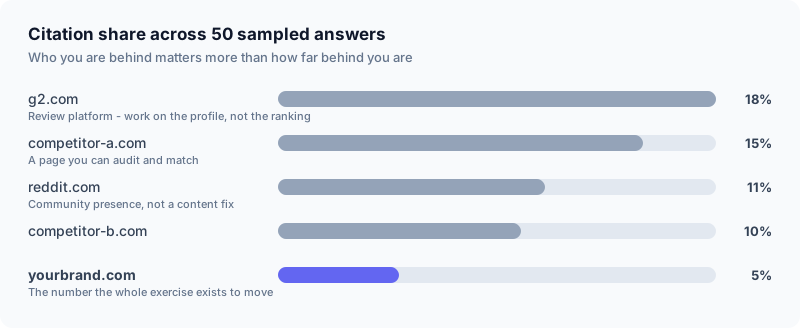
Now you have something to move. Three things are immediately readable: whether you are behind a competitor or behind a review platform (a completely different problem), how concentrated the citation pool is, and what a realistic target looks like next quarter.
Segment it further by URL rather than domain and the content plan writes itself:
| Your cited page | Citations | Prompts it wins |
|---|---|---|
| /pricing | 11 | cost and comparison prompts |
| /blog/some-guide | 7 | how-to prompts |
| /features | 3 | capability prompts |
| /comparison-page | 0 | none |
A comparison page earning zero citations while comparison prompts are the ones you most want to win is not a mystery to solve, it is a rewrite to schedule.
What to do with what you find
If review platforms dominate. G2, Capterra and TrustRadius appearing above every vendor is normal in software categories. You are not going to outrank them, so work on them instead: current profile, recent reviews, accurate category placement. Perplexity cites the platform, and what the platform says about you is what gets synthesised.
If Reddit and forums dominate. Usually a problem-led prompt set. The fix is being genuinely present in the communities where your category is discussed, not astroturfing them - Perplexity reads the thread, and a thread full of thin promotional replies reads exactly like a thread full of thin promotional replies.
If one competitor page dominates. Run a GEO audit on that URL. You will get the structural signals it sends - schema, freshness, answer density, heading structure - and a list of what you can match. Then publish, wait a full tracking cycle, and re-measure.
If you are cited but not named in the answer. The most common and most fixable pattern. Perplexity read your page and credited someone else's framing. It usually means your page explains the topic without ever stating clearly who you are and what you do. Add a plain declarative sentence naming your brand and its category near the top.
Common mistakes
- Counting domains instead of URLs. Domain-level data tells you that you are cited. URL-level data tells you what to write next.
- Sampling once. The citation list reorders between runs. A single capture is a screenshot of a moving thing.
- Ignoring the sources that are not competitors. Most of your missing citation share is usually held by publishers, review sites, and communities, not rivals.
- Tracking only Perplexity. It is the most transparent engine, so it becomes the one everyone measures. Grounded Gemini returns sources too, and ChatGPT Search returns some. Compare across engines - the LLM rank tracker view exists for this.
- Treating citation rank as answer rank. Being source #1 and being the first brand named in the answer text are different outcomes with different causes.
FAQ
Can I see Perplexity's source URLs without a tool?
Yes. Every Perplexity answer displays its sources; expand the panel and copy them. That works for a one-off audit. For a trend you need repeated automated capture, because the list changes between runs.
How many sources does Perplexity cite per answer?
Typically five to ten, varying by model and question complexity. Sonar Pro generally retrieves more than base Sonar. Make sure any tool you use stores the whole list - truncation quietly skews every share metric built on top of it.
What is a good citation share?
There is no universal number; it depends entirely on how concentrated your category's citation pool is. The useful target is relative: your share compared to your closest competitor's, tracked over time. Moving from 5% to 8% while the leader stays flat is a real gain regardless of the absolute figure.
Do Perplexity citations send traffic?
Some, and less than you would like. The value is upstream of the click - being the source the answer is built from shapes what the reader believes before they ever visit anyone's site. Treat citations as share of the answer, not as a traffic channel.
How is citation tracking different from rank tracking?
Citation tracking captures which URLs Perplexity read. Rank tracking captures where your brand places in the answer. They correlate but diverge often, which is exactly why the two together are more useful than either alone. Perplexity brand tracking covers the mention side of the same picture.