
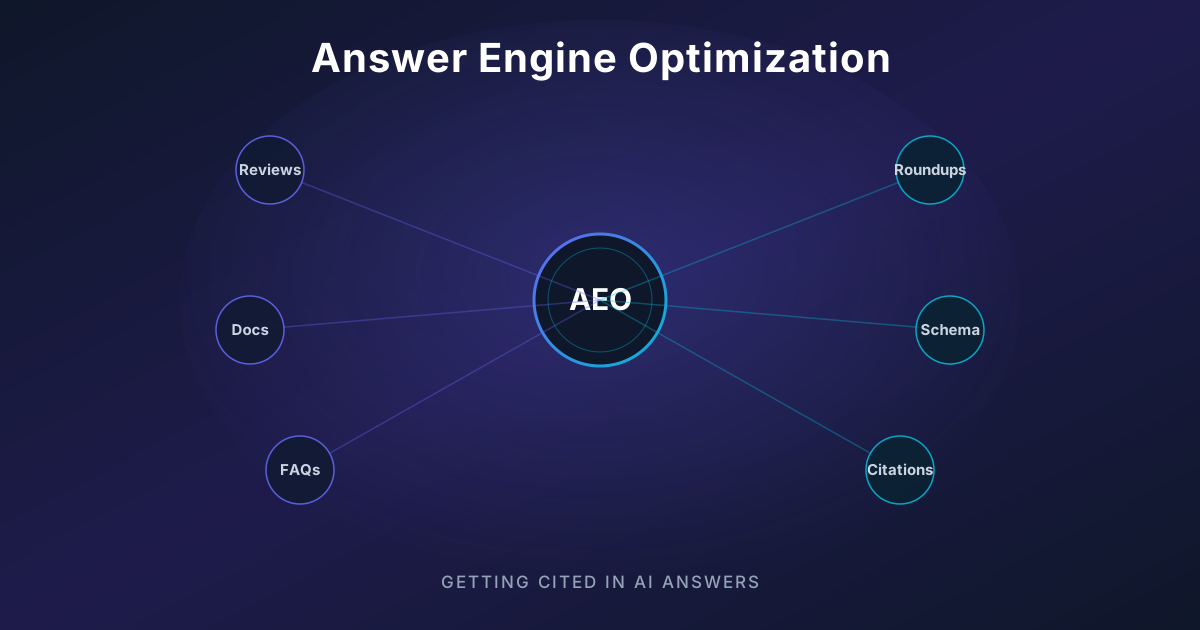
What is answer engine optimization (AEO)?
Answer engine optimization (AEO) is the practice of optimizing your content so that AI answer engines - ChatGPT, Perplexity, Google AI Overviews, Claude, Gemini, and Grok - cite, mention, and recommend your brand in their generated answers.
Where traditional SEO aims to rank a page in a list of blue links, AEO aims to become part of the answer itself. When someone asks an AI assistant "what's the best project management tool for agencies?" or "is [your brand] any good?", AEO is the work that determines whether your brand shows up in the response - and how it's described.
The shift matters because buyer behaviour has moved. Hundreds of millions of people now ask AI assistants the research questions they used to type into Google. If your brand is invisible in those answers, you lose the consideration set before a human ever visits your site.
AEO vs SEO vs GEO: what's the difference?
These three terms overlap, and the industry uses them loosely. Here's the clean distinction:
| Term | Optimizes for | Goal |
|---|---|---|
| SEO (Search Engine Optimization) | Google/Bing ranked results | Rank a page in the blue links |
| AEO (Answer Engine Optimization) | AI answer engines & featured answers | Get cited in the generated answer |
| GEO (Generative Engine Optimization) | Generative AI models | Influence what the model generates about you |
In practice, AEO and GEO are nearly synonymous - both are about winning the AI answer rather than the ranked list. Some teams use "AEO" to emphasise answer engines like Perplexity and Google AI Overviews, and "GEO" to emphasise generative models like ChatGPT. We treat them as the same discipline. For the full playbook, see our generative engine optimization guide and the deep-dive on what generative engine optimization is.
The important point: AEO does not replace SEO. Strong traditional SEO is often a *prerequisite* for AEO, because many answer engines ground their responses in live search results. But ranking #1 on Google no longer guarantees you're in the AI answer - so AEO is now a separate line item.
How answer engines choose what to cite
To do AEO well, you have to understand how the engines decide. Across ChatGPT, Perplexity, Gemini, and Google AI Overviews, the same signals recur:
- Training presence. The model has to have "seen" your brand across the open web - reviews, comparisons, documentation, forums, and authoritative articles - during training.
- Live retrieval. For grounded engines (Perplexity, ChatGPT Search, AI Overviews), the answer is assembled from pages retrieved at query time. Fresh, indexable, well-structured pages win here.
- Structure and clarity. Answer engines disproportionately quote content with clear headings, short scannable answers near the top, schema markup, and explicit question-and-answer formatting.
- Third-party corroboration. Being named consistently across high-authority sources (review sites, roundups, Wikipedia) makes a model far more likely to recommend you.
- Freshness and dates. Visible publish and update dates increase the odds of being retrieved for current-year queries.
The brands that win AEO combine strong traditional search visibility with the structural signals AI engines actually quote: clean headings, concise answers, schema, and consistent third-party mentions.
The AEO tactics that actually move the needle
- Answer the question in the first 100 words. Lead every key page with a direct, quotable answer, then expand. This is the single most-cited pattern in AI answers.
- Add FAQ blocks with real buyer questions. Structured Q&A is the format answer engines lift most often. Mark it up with FAQ schema.
- Publish comparison and "best of" content. Answer engines love to synthesise "best X for Y" answers from listicles and comparison pages. Being present in them is often decisive.
- Earn consistent third-party mentions. Get named accurately on review sites, roundups, and category pages. This shapes what the model recommends more than your own marketing pages.
- Ship an llms.txt file. Tell AI crawlers how to read your site and which pages matter.
- Keep facts consistent everywhere. Pricing, founding year, integrations, and positioning should match across your site and third-party sources - contradictions get you mis-described or ignored.
- Run a free GEO audit on your highest-intent pages to score their AI citation-readiness and get prioritized fixes.
How to measure AEO
AEO without measurement is guesswork - and because AI answers are non-deterministic, a single manual check tells you almost nothing. The metrics that matter:
- Mention rate - the share of relevant prompts where an engine names your brand at all.
- Share of voice - your mentions versus total brand mentions on the same prompts.
- Citation share - which of your pages (and competitors') the engine actually cites.
- Recommendation rank - where you land when the engine lists options.
- Sentiment - how you're described, not just whether you're named.
An AEO tracking platform runs your target prompts across every engine on a schedule, aggregates many runs into stable numbers, and charts the trend. Livesov does this across ChatGPT, Perplexity, Claude, Gemini, and Grok - see ChatGPT brand tracking, Perplexity brand tracking, and the Perplexity rank tracker for engine-specific detail.
AEO tools and AEO insights companies
The category of "AEO insights companies" and answer-engine-optimization platforms has grown fast. Most fall into two camps: enterprise suites with bundled content production and managed service, and self-serve trackers you can start with today. We break down the landscape in our guide to the best AI search optimization tools and the best AI brand monitoring tools.
The pragmatic path for most teams: start by measuring where you stand (a free audit plus a week of tracking), fix the highest-intent pages against real numbers, then re-measure.
AEO FAQ
Is AEO the same as SEO?
No. SEO optimizes to rank a page in search results; AEO optimizes to get cited in AI-generated answers. They're complementary - strong SEO helps AEO because many answer engines ground on live search results, but ranking #1 no longer guarantees you appear in the AI answer.
Is AEO the same as GEO?
Effectively yes. AEO (answer engine optimization) and GEO (generative engine optimization) both aim to win the AI answer rather than the ranked list. The terms are used interchangeably; the tactics are the same.
How do I start with AEO?
Run a free GEO audit on your most important pages, add a direct answer and FAQ block to each, ensure your facts are consistent across the web, then track your mention rate and citations across AI engines so you can see what's working.
Ready to measure your answer-engine visibility? Start a free 7-day trial - no credit card required.