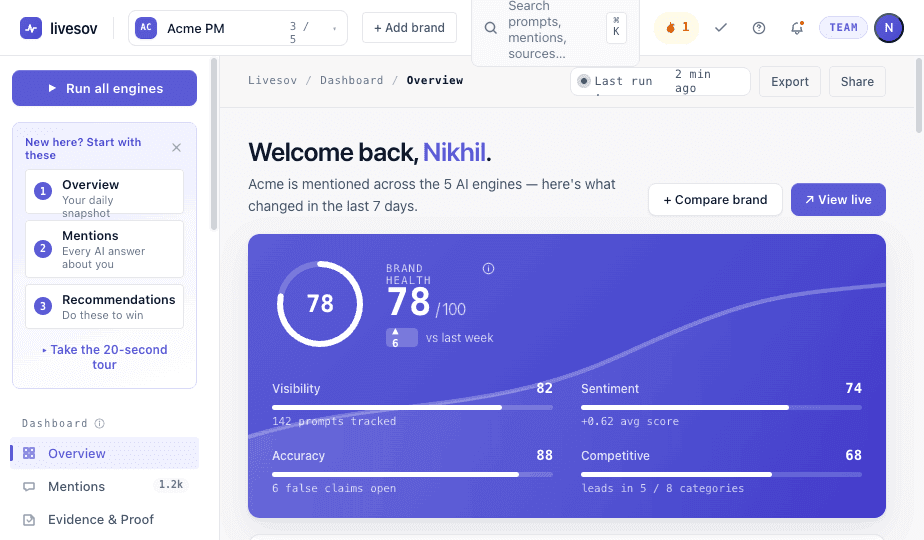
Livesov is a ChatGPT rank tracker built for AI answers, not Google SERPs. It tracks where you rank across GPT-5, GPT-5 mini, ChatGPT Search for the prompts and keywords that matter, records the sources ChatGPT cites, and charts how your position trends over time - so "ChatGPTrank tracking" becomes a measured number instead of a guess.
The ChatGPT Rank Tracker
Livesov is the ChatGPT rank tracker that records where your brand lands when ChatGPT recommends options for your target prompts - then tracks how that rank moves over time. Benchmark competitors, capture ChatGPT Search citations, and start free with no credit card.
7 day free trial · No credit card · Plans from $9/mo
4+
ChatGPT models tracked
20
Competitors benchmarked
24/7
Automated rank tracking
7-day
Free trial, no card
What we track
Six dimensions of ChatGPT rank
ChatGPT answers are highly non-deterministic and vary by model, so rank tracking here means aggregating many runs across GPT-5, GPT-5 mini, and ChatGPT Search to get a stable position.
Prompt & keyword rank
Track your exact position each time ChatGPT lists or recommends options for your target prompts and keywords.
Rank trend lines
See daily, 2-day, or weekly movement in your ChatGPT rank over time - not a single misleading snapshot.
Competitor rank benchmarking
Compare your ChatGPT position against up to 20 competitors on the same prompts, and watch the gap change.
Citation & source tracking
Capture the URLs ChatGPT cites so you know which pages drive each ranking - yours and competitors'.
Share of voice
Your share of all brand mentions across your tracked ChatGPT prompts, scored over time.
Rank-change alerts
Get emailed when your ChatGPT rank moves up or down, with the evidence attached.
How it works
Live ChatGPT rank tracking in under 5 minutes
Add brand, competitors & prompts
Add your brand, domain, competitor set, and the target prompts and keywords you want to rank for in ChatGPT.
Automated ChatGPT runs
Livesov queries ChatGPT on your schedule and stores the full answer every time, so you can see how a non-deterministic engine drifts run to run.
Record rank, citations, competitors
Every run records your position, the cited sources, sentiment, and where competitors placed on the same prompt.
Track trends, export, get alerts
Watch your ChatGPT rank trend over time, export evidence to CSV or PDF, and get alerts when your position moves.
Why track your ChatGPT rankings?
More than 300 million people a week ask ChatGPT for recommendations and comparisons. When ChatGPT lists options in your category, your position in that list is the new page-one ranking - and traditional rank trackers cannot see it.
ChatGPT answers are non-deterministic and differ across GPT-5, GPT-5 mini, and ChatGPT Search. A one-off check is noise. To know your real ChatGPT rank you need multi-run tracking across models, aggregated into a stable position and charted over time.
Livesov runs your target prompts against ChatGPT on a schedule, records your rank and any ChatGPT Search citations each time, benchmarks competitors, and charts the trend - with alerts when your position moves.
Rank is a trend, not a snapshot
Because AI answers change between runs and across models, one check tells you almost nothing. The reliable signal is a rank trend built from many runs over time - which is exactly what Livesov automates on every paid plan.
Why Livesov for ChatGPT rank
Livesov vs. manual ChatGPT rank checks
A spreadsheet of copy-pasted answers is not a rank tracker. Tracking AI rank needs scheduled, multi-run measurement with a competitor benchmark.
| Capability | Livesov | Manual ChatGPT checks |
|---|---|---|
| Automated ChatGPT rank tracking | ✓ Scheduled | ✗ Manual re-checks |
| Rank trend history over time | ✓ | ✗ Snapshot only |
| Run-over-run history (non-deterministic answers) | ✓ Every scheduled run | ✗ Single shot |
| Competitor rank benchmarking | ✓ Up to 20 | Manual |
| Citation / source capture | ✓ Full ranked list | Partial |
| Rank-change alerts | ✗ | |
| Evidence export (full response) | ✓ CSV + PDF | Copy-paste |
| Free to start | ✓ 7-day, no card | n/a |
ChatGPT rank tracker - FAQ
What is a ChatGPT rank tracker?
A ChatGPT rank tracker measures where your brand or pages appear when ChatGPT lists or recommends options for a set of target prompts, and how that position changes over time. Because ChatGPT answers are non-deterministic and vary by model, it runs each prompt multiple times across models and aggregates the result into a stable rank.
Is there a free ChatGPT rank tracker?
Livesov offers a 7-day free trial with no credit card, plus a free GEO audit and free one-off tools with no signup, so you can track your ChatGPT rankings before paying. A free ChatGPT mention checker is also available in the tools hub. Paid plans start at $9/mo.
How does Livesov track ChatGPT rankings?
Add your brand, competitors, and target prompts. Livesov queries ChatGPT (GPT-5, GPT-5 mini, and ChatGPT Search) on a schedule, runs each prompt several times to average out variance, and records your position, any cited sources, sentiment, and competitor placement - then charts the trend and alerts you when rank moves.
How is this different from ChatGPT brand tracking?
They overlap. Rank tracking focuses on your position and how it trends over time for specific prompts and keywords; brand tracking focuses on whether and how ChatGPT mentions, describes, and recommends your brand. Livesov does both - see the ChatGPT brand tracking page for the mention-and-sentiment angle.
Can I track competitor rankings in ChatGPT?
Yes. Livesov benchmarks up to 20 competitors on the same prompts, so you can see who ChatGPT ranks above you, on which queries, and how the gap changes over time.
Does it work with ChatGPT Search citations?
Yes. When ChatGPT Search returns source URLs, Livesov logs the full list, so you can see which pages feed the answers that determine your rank.
Track rank across every AI engine
Free ChatGPT mention checkerCheck one prompt now, no signup needed.Perplexity rank trackerTrack your rankings in Perplexity answers too.LLM rank trackerOne rank tracker for every AI engine - ChatGPT, Claude, Gemini, Perplexity, and Grok.Free GEO auditScore any URL for AI citation-readiness in seconds.Free AI search tools10 free tools - most need no signup.Pricing & plansStart free, scale to agency multi-brand tracking.How Livesov worksMethodology and data pipeline explained.
See what AI says about your brand in 90 seconds.
Track ChatGPT, Perplexity, Claude, Gemini and Grok. 7 day free trial, no credit card.