
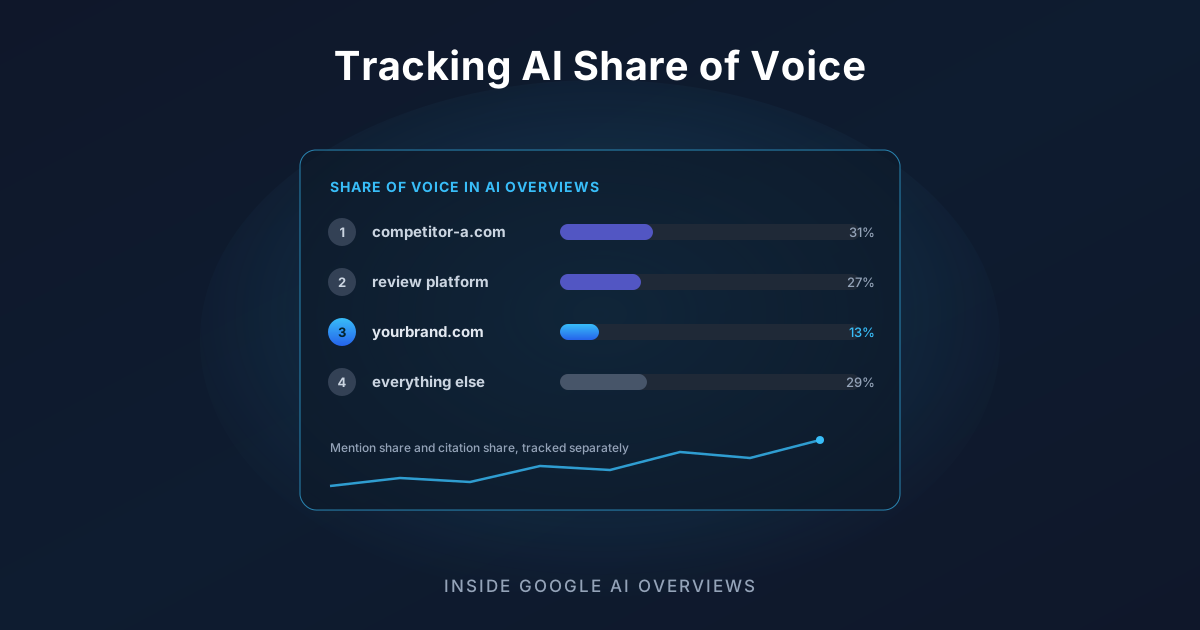
What AI share of voice means here
Share of voice in AI search is your share of all brand mentions across a fixed set of prompts. In AI Overviews specifically it splits into two related metrics that behave differently and should be reported separately.
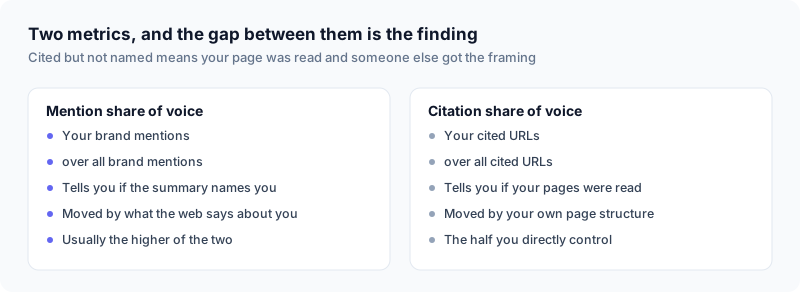
They diverge, and the divergence is the useful part. Being cited without being named means the summary was built partly from your page and credited the framing to somebody else. Being named without being cited means the web talks about you and your own pages are not what is being read.
Why AI Overviews are a different tracking problem
AI Overviews are not an assistant. Assistants take a conversational prompt; AI Overviews are triggered by a search query and appear above the organic results. That difference changes the whole measurement design.
- Query-triggered, not prompt-triggered. You sample keywords, not conversational prompts. Your existing keyword list is the starting point.
- Not every query triggers one. Whether an Overview appears at all is itself a data point worth tracking, and it moves.
- Location and personalisation matter. The same query can produce different Overviews in different locations. Fix your locale and keep it fixed.
- Fewer sources. An Overview typically cites a handful of links, far fewer than a Perplexity answer, which makes each citation slot worth proportionally more.
- It sits above your organic result. You can hold position one and still lose the click, which is exactly the failure mode this metric exists to catch.
Worth restating plainly, because it causes real reporting errors: AI Overviews are not Gemini. Gemini is the assistant, Overviews are the summary block inside Search. Related infrastructure, overlapping data, frequently different answers. Track them as separate surfaces - tracking brand mentions in Gemini covers the assistant side.
Building the measurement
Step 1: pick the query set
Start from the commercial keywords you already track in Google. Prioritise:
- Comparison and "best" queries - the highest AI Overview trigger rate in most categories, and the ones that shape shortlists
- Question queries - "how do I", "what is the best way to", where a summary is the natural answer
- Category queries - your core commercial terms
Thirty to sixty queries is a workable panel. You want enough that one anomalous Overview does not swing the number, and few enough that you will actually look at the results.
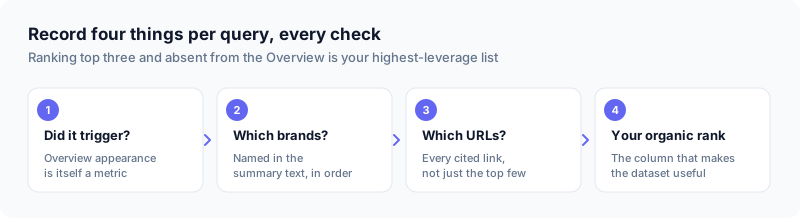
Step 2: record four things per query
For every query, on every check:
- Did an Overview appear? Trigger rate is a metric in its own right.
- Which brands are named in the Overview text? In order.
- Which URLs are cited? All of them.
- Your organic position for the same query.
That fourth column is what makes the dataset worth building. The queries where you rank in the top three and are absent from the Overview are your highest-leverage list: retrieval is finding you and the summariser is choosing something else, which is a page-structure problem, not a rankings problem.
Step 3: calculate
Mention SOV = your brand mentions / all brand mentions across the panel.
Citation SOV = your cited URLs / all cited URLs across the panel.
Worked example over a 40-query panel:
| Count | Share | |
|---|---|---|
| Queries triggering an Overview | 26 of 40 | 65% trigger rate |
| Total brand mentions across those 26 | 71 | - |
| Your brand mentions | 9 | 12.7% mention SOV |
| Total citations | 104 | - |
| Your cited URLs | 7 | 6.7% citation SOV |
Mention share ahead of citation share, as here, is the common shape: the web says enough about you to get you named, while your own pages are not the ones being read. The fix is on your pages.
Step 4: track the trend, not the number
The absolute figure means little without a baseline - it depends entirely on how many brands your category's Overviews typically name. What matters is your share relative to your closest competitor, moving over time. Re-measure on a fixed cadence with the same query set and the same locale.
Turning the number into work
Rank well but not cited. Your highest-value fix. The page is being retrieved and passed over. Usually it buries the answer: no direct response near the top, headings that do not match the question, the key fact sitting in paragraph nine. Run a GEO audit on those specific URLs.
Cited but not named. Add a plain declarative sentence stating who you are and what you do, near the top of the page. Summarisers lift framing from clear statements and skip pages that explain a topic without ever identifying the author's position in it.
Neither ranked nor cited. This is an ordinary SEO problem wearing a new hat. You cannot be summarised from a page nobody retrieves.
A competitor dominates. Look at what is actually being cited. If it is their page, audit it and match the structure. If it is a review platform or a publisher, that is a different project - and often an easier one, because getting your entry on an already-cited source is faster than displacing it.
FAQ
How do I measure share of voice in AI Overviews?
Fix a query panel, check each query on a schedule from a fixed locale, and record whether an Overview appeared, which brands it named, which URLs it cited, and your organic position. Your mention SOV is your share of brand mentions; citation SOV is your share of cited URLs. Track both over time.
Are AI Overviews the same as Gemini?
No. AI Overviews is the summary block inside Google Search; Gemini is the standalone assistant. They share infrastructure and often disagree. Track them separately - a strong Gemini position is not evidence you are cited in Overviews.
What is a good AI share of voice?
There is no universal benchmark, because it depends on how many brands your category's answers typically name. Use your closest competitor's share as the reference point and track the gap.
Do AI Overviews reduce my traffic?
They reduce clicks on queries where the summary fully answers the question - click-through to the top organic result falls substantially when an Overview appears. See the AI search statistics page for the sourced figures. The mitigation is being in the summary rather than only beneath it.
Does Livesov track AI Overviews?
Livesov tracks the five major AI assistants - ChatGPT, Claude, Gemini, Perplexity, and Grok - not the AI Overviews block inside Google Search. For Overviews specifically, Otterly.ai covers that surface; we say so on the Otterly alternative page. The method above works with either, or by hand.