
Why Gemini is the engine teams under-measure
Gemini is not a side channel. It ships inside Google Search, Workspace, and Android, which means for a very large number of people it is not the assistant they chose - it is the one that was already there. That distribution makes it the AI surface with the shortest path from question to answer, and the one where being absent costs most quietly.
It is also the engine where AI visibility and classic SEO overlap hardest, and where the overlap is most misleading. Grounded Gemini answers retrieve live web results, so teams assume their Google rankings carry over. They partly do. The gap between "we rank third in Google" and "Gemini does not mention us" is one of the most common findings in a first tracking cycle, and you cannot see it without measuring both.
What you are actually tracking
Four distinct signals, and conflating them is the usual source of confusion.
| Signal | Question it answers | Why it matters |
|---|---|---|
| Mention rate | What share of Gemini answers name your brand? | The baseline. Absence is invisible in analytics. |
| Position | When named among options, where do you place? | Order is a recommendation, whether or not it is meant as one. |
| Sentiment | How does Gemini describe you? | Being named with a caveat is not the same as being named. |
| Grounded sources | Which URLs produced the answer? | The only lever you can pull directly. |
The Gemini rank tracker covers position specifically; Gemini brand tracking covers the mention-and-sentiment side. This guide is about running the measurement.
Step 1: build a prompt set that reflects buying, not branding
The most common failure is a prompt set full of questions you already win. "What is [your brand]" is answered correctly and teaches you nothing.
Build across three families:
- Category prompts - "best [category] software for [segment]", "what tool should I use to [job]"
- Comparison prompts - "[you] vs [competitor]", "alternatives to [competitor]"
- Problem prompts - the symptom your product cures, phrased as a person would say it out loud
Twenty to forty prompts is enough to be representative. Fewer and one weird answer swings your whole number; many more and you are paying for precision you will not act on. Our free prompt generator will build a starting set from your category if you want a running start.
Step 2: cover the model spread
Gemini is a family, not a model, and the family disagrees with itself. Flash Lite, Flash, and Pro produce measurably different answers to the same question - and the cheap models are the ones serving most consumer surfaces, so tracking Pro alone flatters you in exactly the direction that matters least.
Track all three where your plan allows. If you must pick one, pick the one closest to what your buyers touch, not the one that gives the nicest answer.
Step 3: decide about grounding, explicitly
This is the decision most teams make by accident.
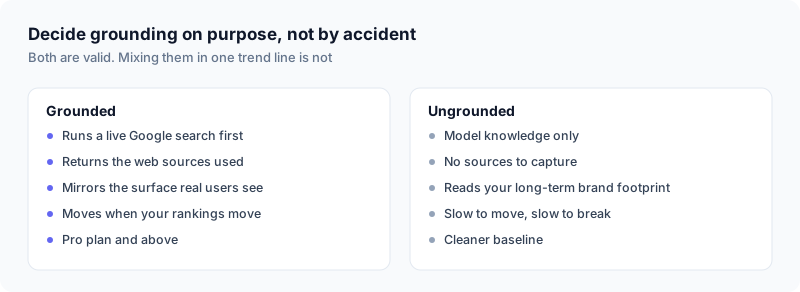
Grounded answers run a live Google search first, then synthesise, and return the web sources used. They reflect the surface real users see and give you citation data to act on. In Livesov, Google Search grounding is available on the Pro plan and above.
Ungrounded answers come from model knowledge alone. They tell you how the model represents your brand independent of what ranks today - slower to move, and a cleaner read on your long-term brand footprint.
Both are legitimate measurements. What is not legitimate is mixing them in the same trend line and wondering why it jumps. Pick one as your reported metric and keep it constant.
Step 4: sample repeatedly, on a schedule
Gemini answers are non-deterministic. Ask the same question three times and you can get three different brand orders. One run is not a measurement.
- Five runs per prompt per check is a sensible floor
- Weekly for most categories, daily where the field moves fast
- Never change the prompt wording once tracking starts - a reworded prompt is a new prompt and it resets your history
Step 5: read the data properly
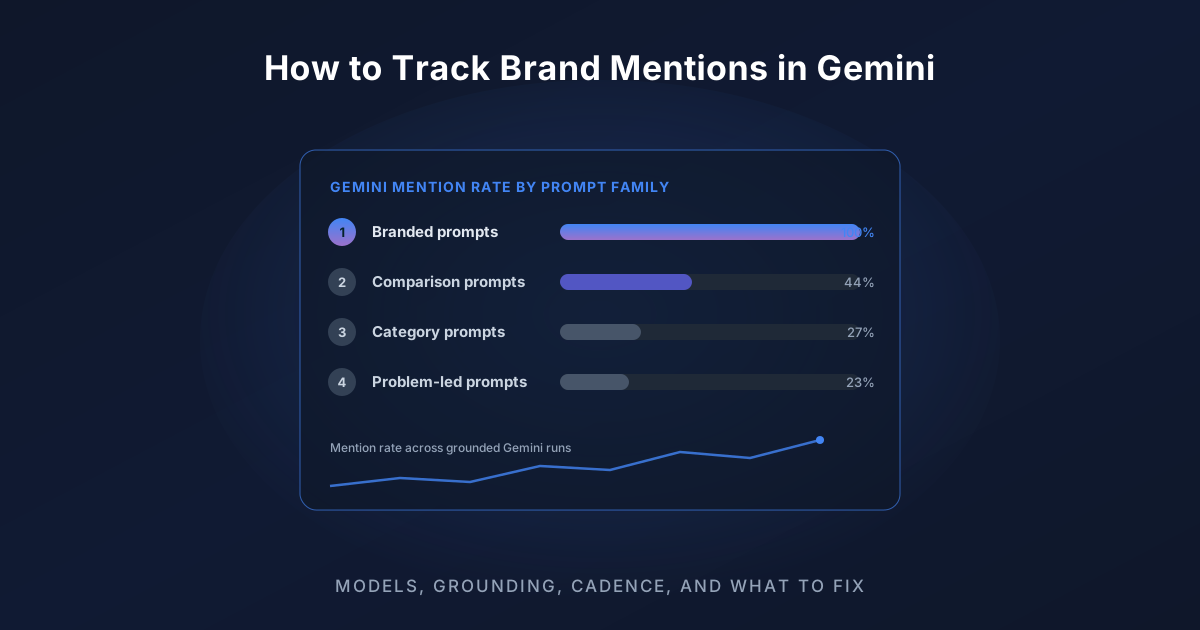
The single most useful cut is mention rate by prompt family:
| Prompt family | Prompts | Runs | Answers naming you | Mention rate |
|---|---|---|---|---|
| Branded | 6 | 30 | 30 | 100% |
| Category | 14 | 70 | 19 | 27% |
| Comparison | 10 | 50 | 22 | 44% |
| Problem-led | 8 | 40 | 9 | 23% |
A shape like this - near-perfect on branded, weak everywhere else - is the standard result of a first measurement, and it is why spot-checking your own brand name gives teams false confidence. You are visible to people who already know you.
Then cross-reference the grounded sources against your Google rankings. Pages that rank well but are never cited are the highest-leverage fix on the list: the retrieval is finding them and the synthesiser is choosing something else, which is a structure and clarity problem, not a rankings problem. Run a GEO audit on those URLs specifically.
Gemini is not AI Overviews
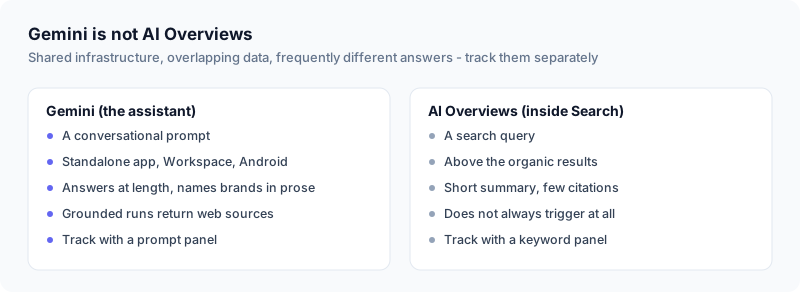
Worth stating plainly, because it causes real reporting errors. Gemini is the assistant. AI Overviews is the summary block inside Google Search results. They share infrastructure, they draw on overlapping data, and they frequently disagree. A strong Gemini position does not mean you are cited in AI Overviews for the same query.
Track them as separate surfaces. We cover the AI Overviews side in how to track AI share of voice in AI Overviews.
FAQ
How do I check if Gemini mentions my brand?
Ask Gemini your real category questions several times each and record whether your brand is named. For a trend rather than a snapshot, use a tool that runs the prompts on a schedule across Gemini models and stores every answer - that is what the Gemini rank tracker does.
Does Gemini use my Google rankings?
Grounded Gemini answers retrieve live search results, so rankings feed in - but they do not decide the outcome. Gemini re-ranks what it retrieves based on how directly a page answers the specific question, which is why well-structured pages routinely get cited over higher-ranking ones.
Can I see which sources Gemini used?
On grounded answers, yes - the web sources come back with the response and can be stored and tracked. Ungrounded answers have no sources to capture, which is one of the practical reasons to decide up front which mode you are measuring.
How often should I track Gemini?
Weekly with five runs per prompt suits most categories; daily where the competitive field moves quickly. Consistency matters more than frequency - a stable cadence with fixed prompts produces a trend you can trust.
What do I do if Gemini never mentions my brand?
Work backwards from the grounded sources. Find out which pages are producing the answers, and get accurate, current, well-structured coverage of your brand into that source pool - your own pages, review platforms, and third-party comparisons. Then re-measure after a full cycle rather than the next day.