
What is generative engine optimization?
Generative engine optimization (GEO) is the practice of optimizing your brand and content so that generative AI engines - ChatGPT, Perplexity, Claude, Gemini, and Grok - mention, recommend, and cite you in their answers. It is the AI-era counterpart to SEO: where SEO earns rankings in a list of links, GEO earns inclusion in the single synthesized answer an AI gives.
For SaaS companies this matters more than for almost anyone, because software buyers increasingly start their research by asking an AI assistant "what is the best tool for X" instead of opening ten browser tabs. If the AI does not name you, you are not in the shortlist - and you never even knew the evaluation happened.
This is the pillar guide. It covers what GEO is, how generative engines choose what to cite, a practical framework for SaaS, and how to measure results. If you want the productized version, Livesov offers generative engine optimization tooling and a GEO optimization service overview.
GEO vs SEO: what actually changes
GEO does not replace SEO - it adds a layer. The underlying work (authoritative, well-structured, trustworthy content) overlaps, but the target and the measurement differ.
| Aspect | Traditional SEO | Generative Engine Optimization |
|---|---|---|
| Goal | Rank in the list of blue links | Be named/cited in the AI answer |
| Output | 10 results, user picks | 1 synthesized answer |
| Signals | Keywords, backlinks, technical SEO | Brand authority, citations, structure, freshness |
| Measurement | Rankings, organic traffic | Share of voice, citation share, sentiment |
| Where you check | Search Console | An AI visibility tracker |
For a deeper primer on the definition, see our companion post on what generative engine optimization is and the AI visibility vs traditional SEO comparison.
How generative engines decide what to cite
Different engines work differently, but they share a common pattern. Retrieval-augmented engines like Perplexity and ChatGPT Search run a live web search, retrieve candidate pages, and ask the language model to synthesize an answer grounded in those sources. Pure-model answers lean on what the model learned in training, which is shaped by how often and how authoritatively your brand appears across the open web.
That means three things drive whether you get cited:
- Retrievability - you rank in or near the results the engine pulls, and your page is crawlable by AI bots.
- Answer-fit - your content directly answers the question the synthesizer is composing, ideally in the first 200 words.
- Extractability - your content is structured cleanly enough (headings, lists, schema) for the model to lift a clean quote.
A GEO framework for SaaS
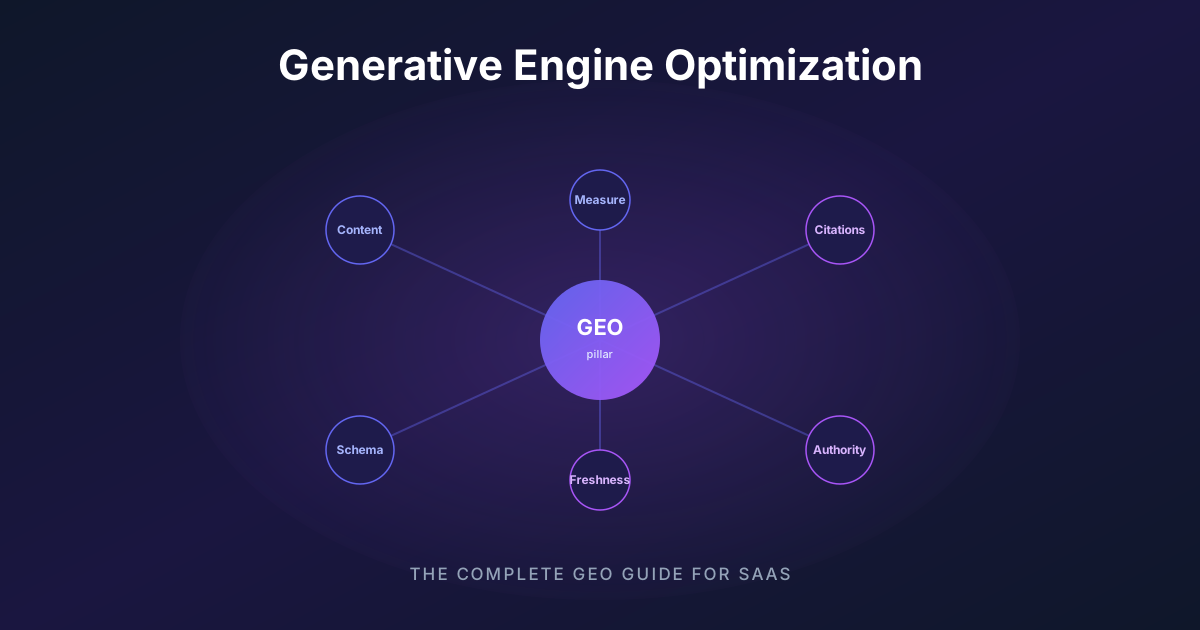
Here is the repeatable loop we recommend. It maps to the six spokes every SaaS GEO program needs.
1. Publish authoritative, answer-first content
Write content that answers real buyer questions directly and early. Lead with the answer, then support it. Cover comparison queries ("X vs Y"), category queries ("best tool for Z"), and alternatives queries, because those are where SaaS buying decisions happen. Use the free prompt generator to find the exact questions your buyers ask.
2. Structure for citation
Generative engines reward scannable structure: a single-question H1, clear H2s, short answer paragraphs, tables, and FAQ blocks. Add Schema.org markup (Organization, Product, FAQ) so machines can parse your meaning. Check any page with the free GEO score checker.
3. Build third-party authority
AI engines cite the wider web heavily - review sites, Reddit, docs, news, and analyst notes. Earn mentions on G2, Capterra, and industry publications. This is often the single biggest lever for SaaS brands, because a review-site page frequently outranks your own site in AI citations.
4. Make your site AI-crawlable
If AI bots cannot read your site, you cannot be cited. Confirm your robots rules allow AI crawlers and publish an llms.txt file. Use the free AI crawler checker and llms.txt generator.
5. Keep content fresh
Generative engines favor recent, maintained content. Update your cornerstone pages on a cadence, add dates, and refresh statistics. Freshness is a ranking signal for retrieval-augmented engines specifically.
6. Measure, then iterate
You cannot improve what you do not measure. Track your share of voice, citation share, and sentiment across engines with a tool like Livesov, ship an improvement, wait one engine cycle, and re-measure.
How to measure the success of your GEO campaigns
Measurement is where most GEO programs fall down. Tie your work to these metrics:
- Share of voice (SOV): the percentage of tracked prompts where your brand is mentioned. Use the share of voice calculator.
- Citation share: how often your domain appears in the source list, and at what rank - the clearest signal on citation-first engines.
- Sentiment: whether the AI describes you positively, neutrally, or negatively.
- Per-platform breakdown: SOV varies enormously by engine; the split tells you where to focus.
- Downstream correlation: rising AI visibility should track with branded search and direct signups over time.
Baseline before you change anything, ship a specific improvement, and re-measure after one engine cycle. That before-and-after is the proof your GEO program works.
GEO for specialized niches
The framework is universal, but the execution varies by industry. Regulated and high-trust niches - for example GEO for law firms - lean harder on authority and accuracy signals, while SaaS leans on comparison content and review-site presence. The measurement loop stays the same.
Frequently asked questions
What is the difference between GEO and SEO?
SEO optimizes to rank in a list of links; GEO optimizes to be named and cited in an AI's single synthesized answer. They share foundational work but are measured differently - rankings and traffic for SEO, share of voice and citations for GEO.
Do I need a GEO service or a GEO tool?
Most SaaS teams start with a tool to measure and a content process to execute. If you want done-for-you help, a generative engine optimization service can accelerate it. Either way, start by measuring your baseline.
How long does GEO take to work?
Retrieval-augmented engines like Perplexity can reflect content changes within a cycle or two of publishing. Pure-model visibility, built on brand authority across the web, compounds over months.
How do I start GEO for my SaaS?
Run a free GEO audit to see your baseline, fix the highest-intent pages using the framework above, and track your share of voice as you go.
Start optimizing for AI answers
GEO is how SaaS brands stay discoverable as buyers shift from search boxes to answer engines. Use this framework, measure relentlessly, and compound your authority. Run your free 90-second GEO audit to see exactly where you stand today.