
The short answer
Yes - tracking brand mentions in Perplexity AI is effective, and it is one of the highest-signal, lowest-cost measurements in modern marketing. It works because Perplexity is citation-transparent: unlike most AI assistants, it shows the exact sources behind every answer, so tracking gives you a clear, actionable diagnosis rather than a vanity number.
The real question is not whether it works, but whether it is worth it for you right now. This article breaks down the evidence, the ROI, and the cases where it matters most.
Why Perplexity tracking is more effective than tracking other AI platforms
Effectiveness comes down to signal quality. Perplexity gives you more usable signal than any other AI surface for three reasons:
- It cites its sources. Every answer includes a numbered list of URLs, so you see not just whether you appear but exactly which pages win and lose.
- It searches live. Perplexity re-queries the web on every question, so your tracking reflects the current state of your visibility, not a stale training snapshot.
- Wins transfer. The work that earns a Perplexity citation - authoritative, well-structured, citable content - is the same work that lifts you in ChatGPT Search, Google AI Overviews, and Bing Copilot. Perplexity becomes a fast, transparent test bed for your entire AI search strategy.
Compare that to ChatGPT, where citations only appear in search mode and less reliably, and it is clear why Perplexity is the platform teams measure first.
What the data shows
Across brands tracked on Livesov, a few patterns come up repeatedly:
- Brands that rank #1 on Google are frequently not the brands Perplexity cites for the same query - traditional rankings do not predict AI visibility. (We cover this gap in AI visibility vs traditional SEO.)
- Because Perplexity gives one synthesised answer, visibility is winner-takes-most: being source 1 vs source 5 is a large difference in influence.
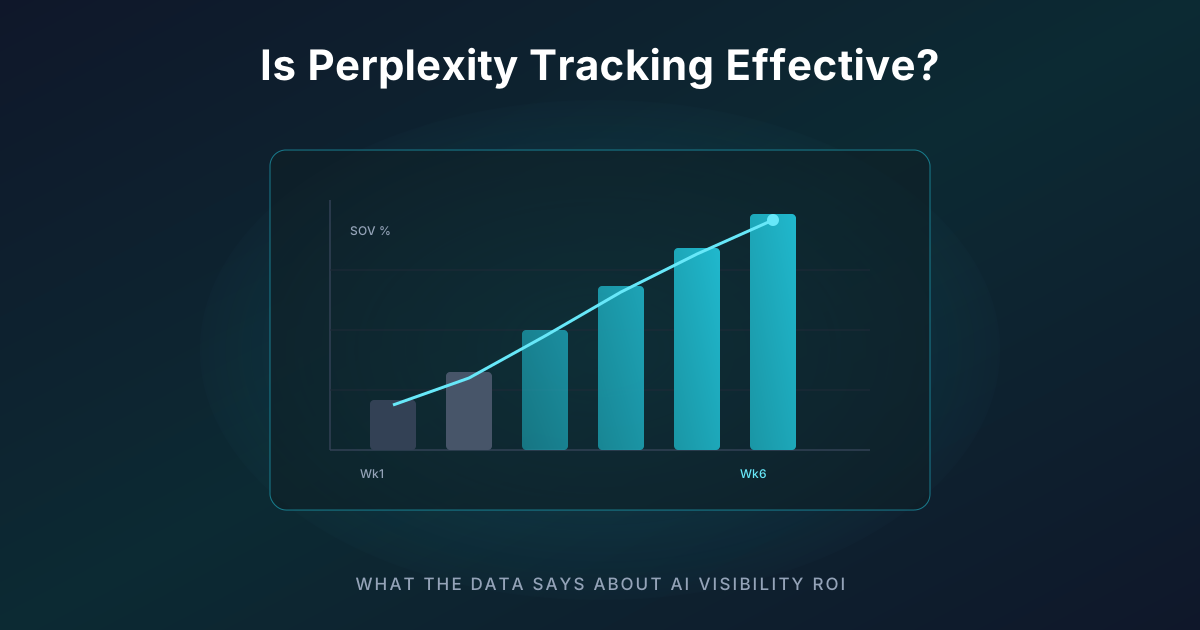
- Teams that track and act on citation gaps typically move share of voice within one to two publishing cycles, because the feedback loop is fast and specific.
The effectiveness is not that tracking magically raises visibility - it is that tracking tells you precisely what to fix, so your optimisation effort stops being guesswork.
The ROI case
Is it worth the time or the tool cost? Weigh it like this:
| Factor | Without tracking | With tracking |
|---|---|---|
| Do you know if AI recommends you? | No | Yes |
| Do you know which competitor wins your queries? | No | Yes, by URL |
| Do you know if your content changes worked? | Guessing | Measured before/after |
| Effort to find out | Repeated manual checks | Automated |
The cost of tracking is small and mostly one-time (or a modest subscription). The cost of not tracking is invisibility in a discovery channel your buyers already use - and no way to tell whether anything you publish is helping. For most brands in a researched category, that asymmetry makes tracking clearly worth it.
When is Perplexity tracking most effective?
It delivers the most value when:
- Your buyers research before they buy - B2B software, professional services, considered purchases. Perplexity is where that research increasingly happens.
- You publish content and need to know if it earns AI citations.
- You compete in a crowded category where citation share is a leading indicator of pipeline inclusion.
- You run an agency and need to prove AI-visibility results to clients with hard evidence. (See our agency playbook.)
It is less urgent if you have no web content to optimise and no competitors being cited - but that describes very few brands in 2026.
How to measure whether tracking is paying off
To keep tracking honest, tie it to outcomes:
- Baseline your Perplexity share of voice before you change anything.
- Ship a specific content or authority improvement.
- Re-measure after one Perplexity cycle and record the SOV and citation-rank delta.
- Correlate rising AI visibility with downstream signals - branded search, direct traffic, demo requests.
If you want to see your starting point in minutes, run a free GEO audit on a key page or start automated Perplexity tracking to capture the baseline and the trend in one place.
Frequently asked questions
Is tracking Perplexity mentions worth it for a small business?
If your customers research your category online, yes. A local or niche business can often reach high Perplexity share of voice faster than a large competitor, because the citation game rewards clear, structured, trustworthy content more than raw domain size.
How quickly will I see results?
Tracking shows results immediately - you get your baseline on the first run. Improvements to your actual visibility usually appear within one to two Perplexity cycles after you ship content changes.
Does Perplexity tracking replace SEO?
No - it complements it. Perplexity visibility and traditional SEO are related but distinct, and the winning teams in 2026 measure both. See AI visibility vs traditional SEO.
What is the easiest way to start?
Pick 15 buyer-intent prompts, run them through Perplexity, and log mentions and citations - or skip the manual work and let Livesov track it automatically.
The bottom line
Tracking brand mentions in Perplexity is effective because it converts a hidden discovery channel into a measurable, fixable one. The effort is low, the signal is high, and the wins transfer to every other AI engine. Start tracking your Perplexity visibility and turn "are we even in the answer?" into a number you can move.