
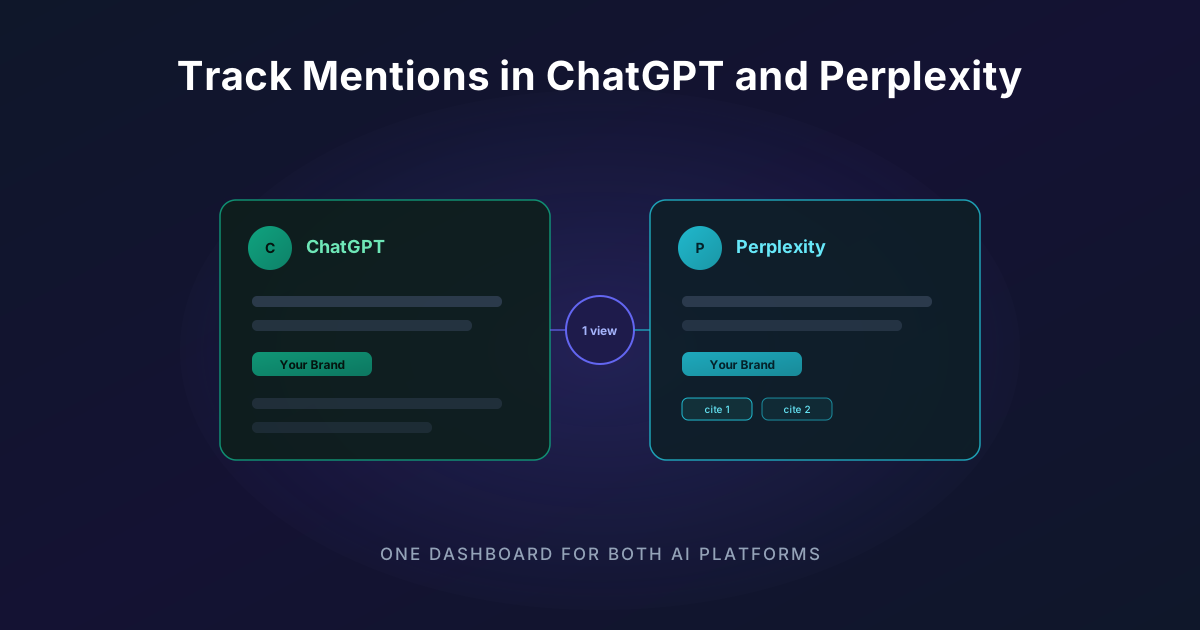
Why track ChatGPT and Perplexity together
ChatGPT and Perplexity are the two AI platforms where most buying-decision conversations now happen. ChatGPT has the largest audience of any AI assistant; Perplexity is the fastest-growing AI search engine and the most citation-transparent. Your buyers use both, often for the same question - so tracking only one leaves half your AI visibility unmeasured.
The good news: the tracking method is largely the same for both, and you can run one prompt set across the pair. The important differences are in what each platform exposes.
How ChatGPT and Perplexity differ for tracking
| ChatGPT | Perplexity | |
|---|---|---|
| Primary signal | Brand mention in answer text | Mention plus explicit citations |
| Citations | Only in search mode, less reliable | Every answer, ranked source list |
| Freshness | Model knowledge plus optional search | Live web search every query |
| Best for | Reach and recommendation share | Diagnostic, source-level analysis |
The practical takeaway: on Perplexity you track mentions and citations (see tracking mentions and citations in Perplexity); on ChatGPT you focus on whether and how your brand is named, since citations are inconsistent. Both roll up into a single share-of-voice picture.
How to track brand mentions across both platforms
Step 1: Build one shared prompt set
Use the same 15 to 30 buyer-intent prompts for both platforms so the results are comparable. Cover category, comparison, alternatives, and branded queries. The prompt generator will draft a category-specific set to start from.
Step 2: Run each prompt on both platforms
Ask every prompt in ChatGPT and in Perplexity, and log the results side by side:
- ChatGPT: Was your brand named? Sentiment? Which competitors were named?
- Perplexity: Was your brand named? Cited (at what rank)? Which competitor domains were cited?
Step 3: Track per-platform and blended share of voice
Compute share of voice for each platform separately, then blend them:
Platform SOV = (prompts mentioning you on that platform / total prompts) x 100
A worked example:
| Platform | Mentioned | Total | SOV |
|---|---|---|---|
| ChatGPT | 11 | 25 | 44% |
| Perplexity | 8 | 25 | 32% |
| Blended | 19 | 50 | 38% |
The per-platform split is the valuable part - it tells you exactly where you are weak. Low ChatGPT SOV points to brand-authority and reputation gaps; low Perplexity SOV points to citable-content gaps. Use the share of voice calculator to run the numbers.
Step 4: Monitor on a schedule, not once
Both platforms change - ChatGPT ships model updates, Perplexity re-searches live every query. A one-time audit ages out within weeks. Re-run the shared prompt set on a fixed cadence and chart the trend per platform.
The scaling problem - and the fix
Tracking one platform manually is tedious. Tracking two doubles every count: 25 prompts across ChatGPT and Perplexity is 50 checks per cycle, before competitors. The results also drift the moment you skip a week.
A unified tracker solves this by running both platforms from one dashboard. Livesov tracks ChatGPT brand mentions and Perplexity mentions and citations - plus Claude, Gemini, and Grok - on a shared schedule, with one blended share-of-voice score, competitor benchmarking, sentiment, and full citation capture where the platform supports it. For the broader method across all five engines, see how to track your brand across AI platforms.
What to do with cross-platform data
- Fix the weaker platform first. If ChatGPT SOV lags, invest in brand authority and reviews; if Perplexity lags, invest in structured, citable content.
- Find the shared gaps. Prompts where you are missing on both platforms are your highest-priority content targets.
- Audit the winners. Run a free GEO audit on whichever competitor URL keeps showing up - the fixes usually help you on both engines at once.
Frequently asked questions
Can I track ChatGPT and Perplexity in one tool?
Yes. Livesov runs a shared prompt set across ChatGPT, Perplexity, and three other AI platforms from a single dashboard, so you get one comparable, blended view.
Do ChatGPT and Perplexity need different prompts?
No - use the same buyer-intent prompts so results are comparable. What differs is what you record: mentions for ChatGPT, mentions plus ranked citations for Perplexity.
Which platform should I prioritise?
Prioritise wherever your buyers research and wherever your SOV is lowest. Perplexity is the more diagnostic platform because of its citations; ChatGPT has the larger reach. Most brands track both.
How often should I track both?
Weekly at minimum. Automated trackers typically run daily or every other day so you catch competitor and content shifts quickly.
Track both platforms from one place
Half your AI visibility lives in ChatGPT and half in Perplexity - measuring one is measuring half. Set up a shared prompt set, capture both, and watch the blended trend. Track ChatGPT and Perplexity mentions with Livesov and put both platforms on one dashboard.