
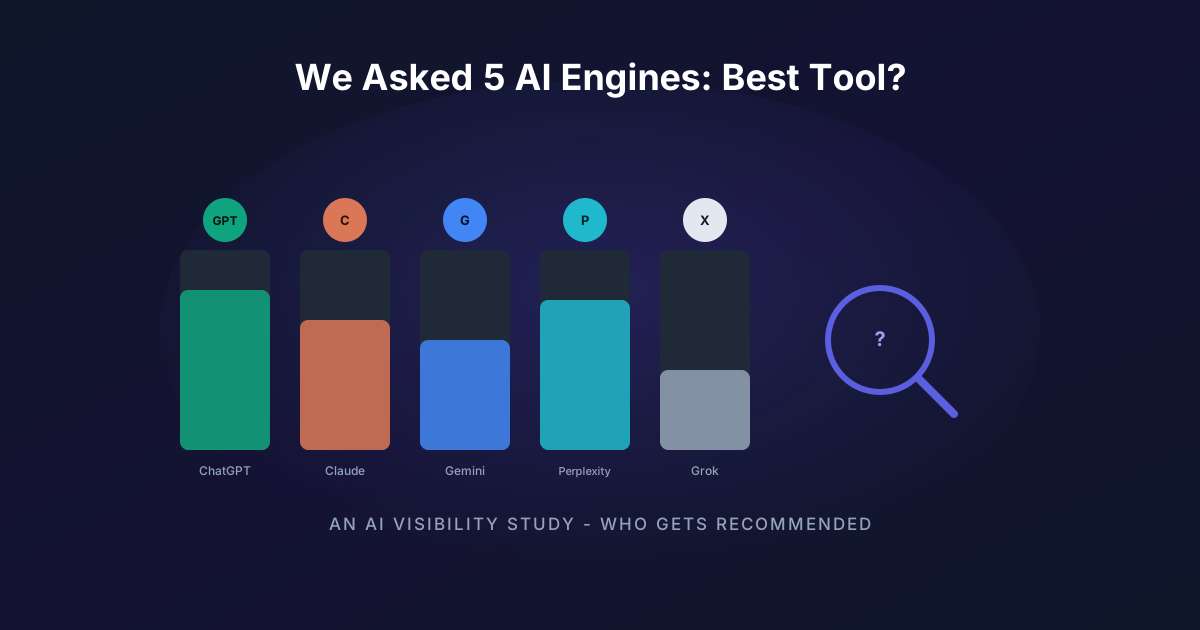
The question behind this AI visibility study
When a buyer asks five different AI engines the same question - "what is the best [category] tool" - do they get the same answer? We designed a repeatable study to find out, because the answer has direct consequences for every brand trying to be discovered through AI.
The short version: no, they do not agree - not even close. The same query produces materially different brand shortlists across ChatGPT, Claude, Gemini, Perplexity, and Grok. Below is the methodology, what the pattern looks like, and exactly how you can reproduce it for your own category.
A note on the data: the figures in this article are illustrative of the patterns we see when running these queries, presented to show the method and the shape of the findings. AI answers vary by phrasing, timing, and model version, so the reliable takeaway is the pattern - large divergence between engines - not any single number. Run the study on your own category with Livesov to get figures specific to you.
Methodology
A trustworthy AI visibility study has to be reproducible. Here is the design:
- Pick a category and a fixed query set. We use a handful of neutral, buyer-style prompts per category - "best [category] tool", "top [category] software", "[category] tool recommendations" - held constant across every engine.
- Query all five engines identically. The same prompts go to ChatGPT, Claude, Gemini, Perplexity, and Grok, with no leading phrasing.
- Record every named brand and, where shown, every citation. For each answer we log which brands are named, in what order, and which source URLs are cited.
- Run multiple times. Because answers vary run to run, we repeat and aggregate rather than trusting a single response.
- Compute share of voice per engine. The percentage of runs in which each brand is named, per platform.
This is the same loop a brand runs continuously with an AI brand monitoring tool - the study is just a snapshot of it.
What the pattern looks like
Aggregated across a category, the recommendation rates for a given brand diverge sharply by engine. A representative shape:
| Engine | How it answers | Effect on brand shortlists |
|---|---|---|
| ChatGPT | Model knowledge, or live search in Search mode | Favors brands with broad, authoritative web presence |
| Perplexity | Live web search, citation-first | Favors well-structured, citable pages that rank in retrieval |
| Claude | Analytical, model knowledge | Favors clearly documented, reputable brands |
| Gemini | Tied into Google's surfaces | Reflects Google-adjacent authority signals |
| Grok | Real-time, X-connected | Favors brands with active social and real-time presence |
The consistent finding: no brand wins everywhere. A brand can dominate Perplexity because its content is citable, yet barely appear on Grok because it has little real-time social footprint - or lead on ChatGPT through sheer web authority while losing Gemini. Read the platform deep-dives in our track your brand across AI platforms guide.
Why the engines disagree
Three structural differences drive the divergence:
- Different knowledge sources. Retrieval-augmented engines (Perplexity, ChatGPT Search) pull live web results; pure-model answers reflect training data and brand authority; Grok weights real-time signals.
- Different ranking signals. Citation-first engines reward structure and retrievability; model-first engines reward breadth and frequency of authoritative mentions.
- Different freshness. Live-search engines reflect what changed yesterday; model knowledge lags.
For brands, the lesson is that AI visibility is not one number - it is five, and you have to earn each one somewhat differently. That is the core argument for generative engine optimization as a multi-platform discipline.
What this means for your brand
If the engines disagree this much, three things follow:
- You cannot extrapolate from one engine. Being recommended by ChatGPT tells you little about Perplexity or Grok. Measure all five.
- Your weakest engine is your biggest opportunity. The platform where you are absent is where a focused push moves the needle most.
- You have to measure continuously. A single study ages out; models update and competitors move. Continuous monitoring is the only way to keep the picture current.
How to run this study for your own category
You can reproduce this in an afternoon:
- Define your query set - the neutral buyer prompts for your category. The prompt generator helps.
- Query each engine and log named brands and citations. For a fast start, the free mention checker and citation finder tools cover the manual version.
- Aggregate across runs into a per-engine share of voice with the share of voice calculator.
- Automate it so the study becomes a living dashboard rather than a one-off, with scheduled runs across all five engines in Livesov.
Frequently asked questions
Do different AI engines really recommend different brands?
Yes - substantially. The same "best tool" query produces different shortlists across ChatGPT, Claude, Gemini, Perplexity, and Grok because they use different knowledge sources, ranking signals, and freshness. Measuring only one engine gives a misleading picture.
Are the numbers in this study exact?
They are illustrative of the patterns we observe, not fixed measurements - AI answers vary by phrasing, timing, and model version. The reliable finding is the divergence between engines. Run it on your own category for figures specific to you.
How can I see which engine recommends my brand?
Run a free 90-second audit for a snapshot across engines, or set up continuous tracking to watch it over time.
Can I use a study like this for PR or link building?
Yes - original AI visibility studies for your own niche are highly linkable and double as a live demonstration of your product. Reproduce the method above with your category's data.
See where your brand lands across all five engines
The engines disagree, which means your brand is probably winning some and invisible on others - and you will not know which until you look. Run your free 90-second AI visibility audit and see exactly who each engine recommends in your category.