
Mentions and citations are two different things
When people ask how to track brand mentions or citations in Perplexity AI, they usually think it is one metric. It is two, and confusing them is the most common tracking mistake:
- A mention is when Perplexity writes your brand name into the answer text.
- A citation is when your domain appears in the numbered source list beneath the answer - regardless of whether the text names you.
Perplexity is unusually good for this kind of analysis because it is a glass box: every answer ships with an explicit, ordered list of source URLs. Where ChatGPT often hides its reasoning, Perplexity tells you exactly which pages it read. That transparency is what makes citation tracking possible at all. If you are new to the topic, start with our step-by-step guide to tracking brand mentions in Perplexity, then come back here for the citation layer.
Why you need to track both
The two metrics diagnose different problems:
| Pattern | What it means | What to fix |
|---|---|---|
| Cited but not mentioned | Perplexity reads your page but names a competitor | Weak brand signals on the cited page |
| Mentioned but not cited | The web talks about you, your own pages are not pulled in | Your properties are not citable enough |
| Both | Healthy AI visibility | Defend and expand |
| Neither | Invisible for that query | Full content and authority push |
Tracking only mentions hides the fact that Perplexity may already trust your content but attribute it to someone else. Tracking only citations hides reputation problems in the answer text. You need the pair.
How to track brand citations in Perplexity, step by step
Step 1: Capture the full ordered citation list
For each prompt, do not just note "cited: yes." Record the entire source list in order, because rank matters:
- Which position is your domain in (source 1, 3, 7)?
- Which competitor domains rank above you?
- Which third-party sources (G2, Reddit, news, docs) does Perplexity lean on?
Citation rank in Perplexity is the new SERP rank. Being source 1 vs source 5 is the difference between the quote the synthesiser lifts most prominently and a link a reader never scrolls to. The free citation finder tool helps you surface which URLs get cited for a query.
Step 2: Track citation share of voice
Aggregate across your whole prompt set:
Citation SOV = (prompts where your domain is cited / total prompts) x 100
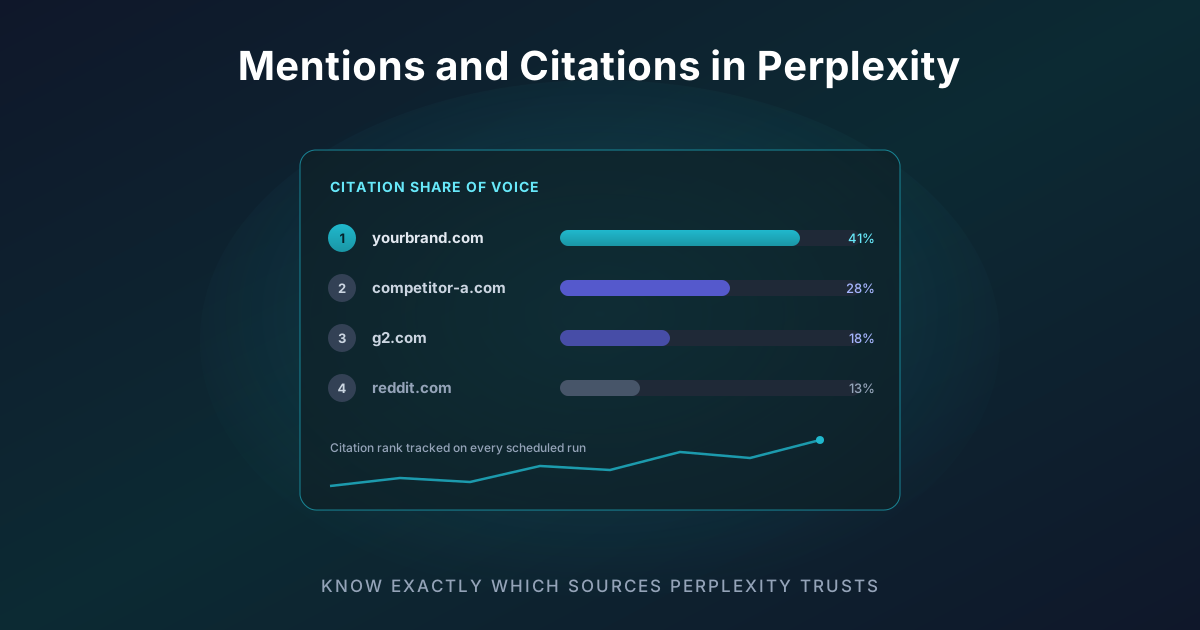
Then do the same for each competitor. The output is a leaderboard of which domains own your category in Perplexity. Chart it over time and it becomes the clearest scorecard you have for AI search.
Step 3: Separate first-party from third-party citations
Not all citations are equal. A citation to your own domain is a direct win you control. A citation to a third-party page about you (a review site, a Reddit thread, a news article) is earned media you influence but do not own. Tag each citation as first-party or third-party so you know whether to invest in content or in PR and reviews.
Step 4: Monitor citation rank shifts after you publish
The whole point of tracking is to close the loop. When you publish or update a page, note the date, wait one Perplexity cycle, and check whether your citation rank moved for the target prompts. This before-and-after is the evidence that your GEO strategy is working - or that it needs another pass.
Why manual citation tracking breaks down
Capturing one full citation list by hand is easy. Capturing every list, for every prompt, on every run, and diffing rank week over week is not. Citation data is only valuable longitudinally - a single snapshot cannot tell you whether you are gaining or losing ground.
This is where a purpose-built tracker earns its place. Livesov's Perplexity citation tracking logs the complete ordered citation list - domain, URL, snippet, and rank - for every tracked prompt and every run, then builds the citation-share trend and competitor benchmark automatically. It covers the full Sonar family (Sonar, Sonar Pro, Sonar Reasoning, Sonar Deep Research) because each one cites a little differently.
Turning citation data into action
Once you can see the citation map:
- Reverse-engineer the winners. Run a free GEO audit on the competitor URL that outranks you. It surfaces the schema, freshness, and structural signals that page is sending so you can match or beat them.
- Prioritise by rank, not just presence. A prompt where you are cited at rank 6 is a bigger opportunity than one where you are absent entirely - you are close.
- Feed PR from third-party citations. If Perplexity keeps citing one review site or forum, that is where to concentrate earned-media effort.
Frequently asked questions
Does Perplexity show citations for every answer?
Yes. Live-search answers in Perplexity include a numbered source list, which is what makes it the most citation-transparent AI platform and the easiest to track precisely.
What is a good citation share of voice in Perplexity?
It is relative to your category and competitors, so benchmark against the domains you compete with rather than an absolute number. The goal is a rising first-party citation share and a rank that trends toward source 1 for your priority prompts.
How is citation tracking different across AI platforms?
Perplexity exposes citations natively, ChatGPT only in its search-enabled mode and less reliably, and most others not at all. If you care about both engines, see tracking mentions in ChatGPT and Perplexity.
Can I export the raw citations?
With Livesov, yes - every response and its full citation list export to CSV or PDF as evidence for clients, executives, or audits.
Track every citation, automatically
Mentions tell you your reputation; citations tell you your sources. Track both and you have the complete picture of your Perplexity visibility. Set up Perplexity mention and citation tracking with Livesov and capture the full ranked source list on every run.